Boot Performance
The Boot Performance analysis of Chop Insights helps you diagnose and optimize the initial startup time of the Mince framework. It provides a detailed breakdown of how long each part of your framework takes to load.
Insights collects statistics on three main areas during startup:
- Mince Modules:
require()time and:Setup()time. - Configs:
require()time and memory usage. - Components:
:Construct()time and instance count.
Interpreting Startup Times
A good benchmark to aim for is a total startup time of under 8 seconds (a combined 4 seconds on the client and 4 seconds on the server). If your overall startup time is longer than this, it’s worth investigating the cause using the Insights dashboard.
A common and highly effective way to speed up loading is to defer non-essential work. If a module’s :Setup() function needs to yield or perform a long-running task that isn’t required for other modules to initialize, wrap its logic in task.defer() to move it out of the critical startup path.
Analyzing Boot Components
Modules
Insights tracks two phases for modules:
- Require Time: This should be as fast as possible. A module should ideally return its table of functions immediately, with minimal logic performed at the top level of the script.
- Setup Time: This is where the bulk of a module’s initialization logic should be. Insights will show you which modules have the longest setup times, making them primary candidates for optimization.
Configs
- Require Time: Configs should load almost instantly, as they should primarily contain static data.
- Memory Usage: Since config files are stored in memory, Insights will highlight the largest configs. This can help you identify if a config file has grown too large and should be refactored.
Components
Insights tracks two key metrics for components at startup:
- Construct Time: The total time spent running the
:Construct()method for all instances of a component. - Construct Count: The number of instances of a component that were created during startup.
While component construction can sometimes take time if dependencies need to be loaded, you should aim to keep the :Construct() method as lean as possible.
Interacting with the Dashboard
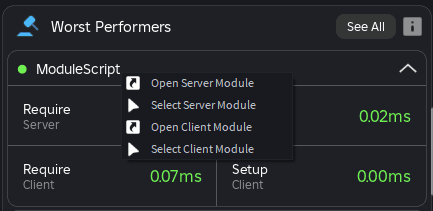
To help you quickly find the source of a performance issue, you can right-click on modules and configs listed in the Boot Performance view. This will open a context menu: